
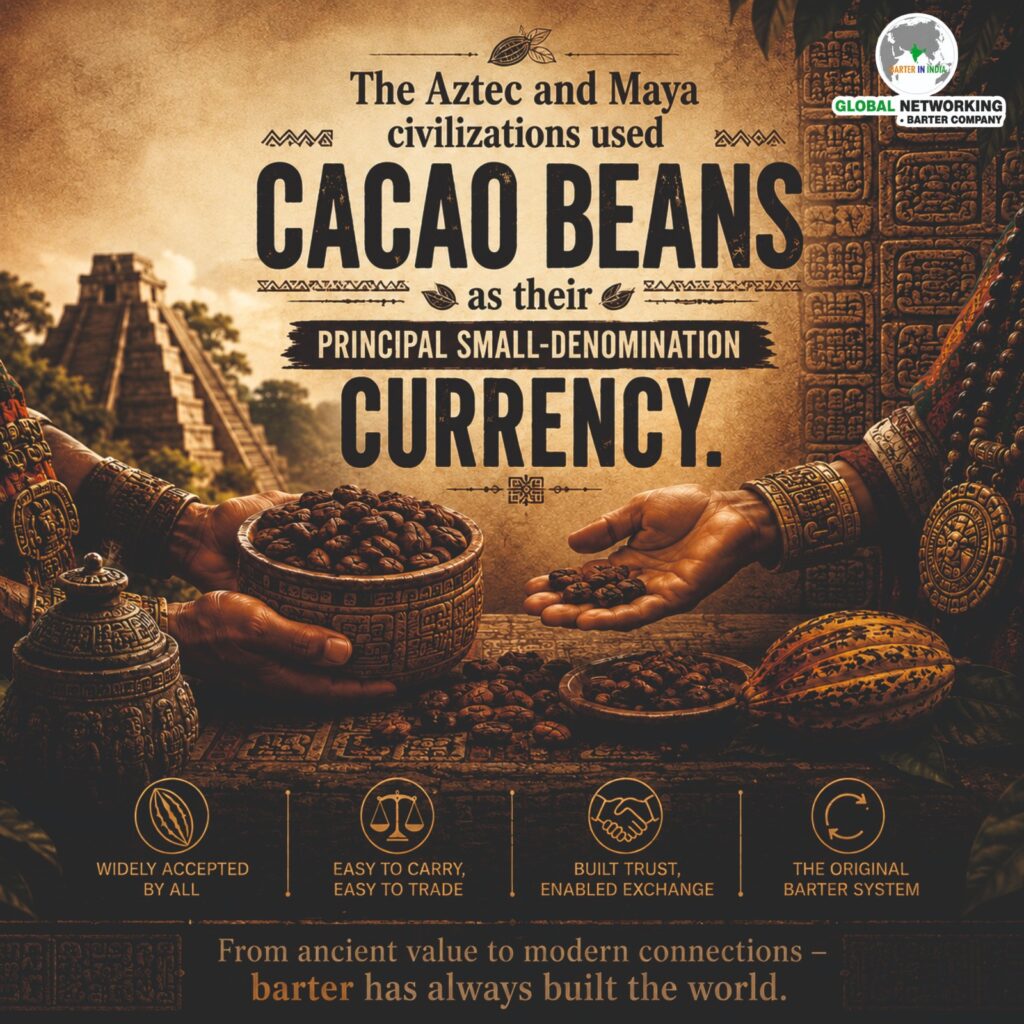
Long before coins and paper money became the standard for trade, ancient civilizations developed creative ways to exchange goods and services. One of the most fascinating examples comes from the Aztec and Maya civilizations, where cacao beans were used as their principal small-denomination currency. More than just the ingredient used to make chocolate, cacao beans played a vital role in commerce, making them one of history’s earliest and most successful forms of value-based exchange.
Cacao Beans: More Than Food
For the Aztec and Maya people, cacao was considered precious. It was widely accepted, easy to carry, and valuable enough to be exchanged for everyday goods and services. In local markets, merchants accepted cacao beans to purchase food, clothing, tools, and other necessities. Because nearly everyone recognized their value, cacao beans functioned much like small coins do today.
Unlike modern currencies issued by governments, the value of cacao beans came from their usefulness, rarity, and universal acceptance within society. This made them an efficient medium of exchange and an important part of the region’s economy.
An Early Example of the Barter System
The use of cacao beans demonstrates how trade evolved from simple barter into more organized systems of exchange. Instead of relying solely on direct product-for-product swaps, people used a commonly accepted commodity that simplified transactions. This innovation made commerce faster, more flexible, and more reliable.
The principles behind these ancient trading methods continue to influence modern business practices. Today’s Business Barter and Corporate Barter networks allow companies to exchange products, services, media, and advertising without immediate cash payments. Modern Barter Exchange systems provide structured platforms where businesses can maximize unused inventory, improve cash flow, and build valuable commercial relationships.
How Modern B2B Barter Continues the Tradition
Although today’s economy is digital and global, the concept remains remarkably similar. Businesses now work with a B2B Barter Agency in India, a B2B Barter Company in Mumbai, or a professional Barter Exchange Company to trade goods and services through organized exchange networks.
A trusted Barter Agency, Barter Company, or Barter Exchange Network in India helps businesses connect with verified trading partners while maintaining fair market value for every transaction. Companies also benefit from Barter Marketing Services, Media Barter Advertising, and Corporate Barter Companies, enabling them to acquire valuable business services without increasing cash expenses.
Whether you’re searching for Barter Companies in India, a Professional Barter Company in Mumbai, a Trusted Barter Agency in India, or an Online Barter Exchange Company, modern barter platforms continue the same fundamental idea that made cacao beans so valuable centuries ago creating mutually beneficial exchanges based on recognized value.
The Legacy of Ancient Trade
The story of cacao beans reminds us that successful commerce has never depended solely on money. Trust, cooperation, and shared value have always been the foundation of trade. The Aztec and Maya civilizations demonstrated that a practical and widely accepted commodity could support thriving markets and strong economies.
Today, advanced Trade Barter Systems, Business Barter Platforms, and Bartering Websites carry forward this timeless principle, helping businesses grow while preserving cash and unlocking new opportunities.
From ancient cacao beans to modern B2B barter exchanges, the evolution of trade proves one enduring truth: when both parties recognize value, commerce thrives.